Levels 1 and 2 covered the 12AX7 and how it works. This level is about applications: the jobs the 12AX7 does best, the jobs where a relative is better, how to change an amp's character by swapping tubes position by position, and buying them.
Where It Shines
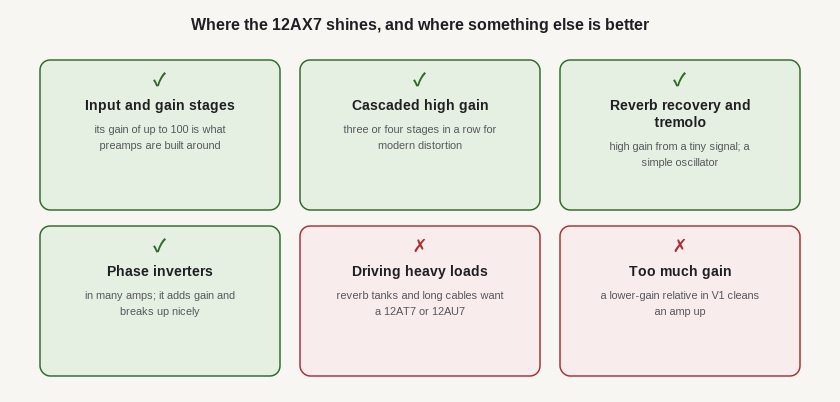
Input and Gain Stages
The job: raising a guitar's fraction-of-a-volt signal to working level, and voicing it on the way.
Why it shines: a gain factor of 100 is more than any other common triode, so it gets the most out of each stage. Its high plate resistance is no drawback here, because the next stage up is a light load.
Cascaded High Gain
The job: three or four stages in a row, each driving the next into clipping, for modern distortion.
Why it shines: high gain per stage means fewer stages for the same distortion, and less noise and complexity.
Reverb Recovery and Tremolo
The job: bringing the tiny signal from a reverb tank back up to mix with the dry sound; making the slow wave that drives the tremolo.
Why it shines: the reverb tank's output is very weak, and the 12AX7's gain raises it with little extra noise. As a tremolo oscillator, its gain keeps a simple circuit oscillating reliably.
Phase Inverters
The job: splitting the signal for the power tubes, often adding gain and breaking up as the amp is turned up.
Why it shines: in a long-tail-pair inverter, a 12AX7 adds gain and overdrives smoothly, which is part of many amps' power-amp character.
Where Something Else Is Better
- Driving heavy loads. A reverb tank's input transformer, an effects loop send into long cables, or a tone stack wants a tube that can supply current: a 12AT7 or 12AU7.
- Too much gain. If an amp breaks up sooner than you want, a lower-gain relative in V1 is the simplest fix.
Swapping by Position
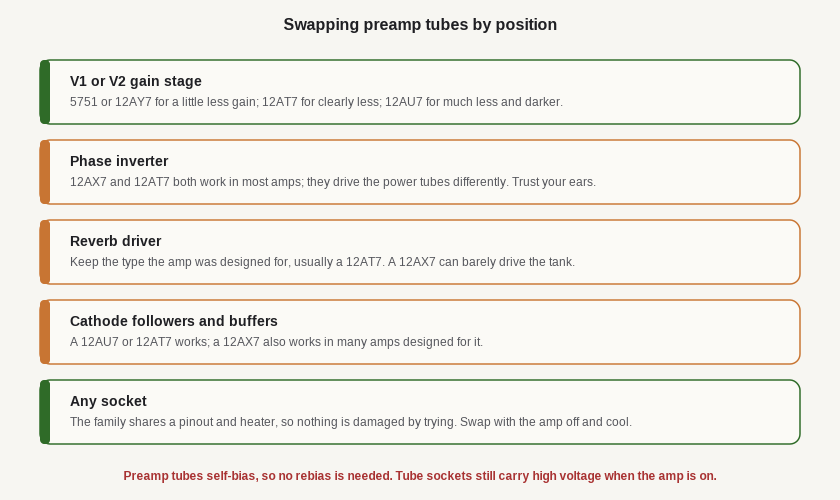
| Position | Try | Effect |
|---|---|---|
| V1 | a 5751 or 12AY7 | a little less gain and noise, same voicing |
| V1 | a 12AT7 | noticeably cleaner, slightly less bass |
| V1 | a 12AU7 | much cleaner and darker |
| V2 (gain stages) | a 5751 | tames a harsh or fizzy high-gain amp a little |
| Phase inverter | a 12AT7 or 12AX7 | changes how hard the power tubes are driven and how the amp breaks up; trust your ears |
| Reverb driver | keep the original (usually a 12AT7) | a 12AX7 can barely drive the tank |
| Reverb recovery | keep a 12AX7 | lower-gain tubes leave the reverb weak |
Because the family shares a pinout and heater, nothing is damaged by trying, and preamp tubes need no rebias. A lower-gain tube in a stage designed for a 12AX7 can sound thin, so treat swaps as experiments and keep the original tubes.
Buying 12AX7s
- Current production: made in Russia, Slovakia and China under many names. Different makes vary in brightness, gain, smoothness and noise.
- Low-noise grades: sold for V1, tested for low noise and microphonics. Worth having for the first stage, and in high-gain amps.
- Names: 12AX7, 12AX7A, ECC83, 7025 and ECC803S all fit the same socket. The extra letters and numbers once meant lower noise or hum; today they are often just branding. Judge by the seller's testing.
- Vintage: old American and European 12AX7s are prized and expensive, and fakes and worn tubes are common. Ask for test data, and expect a used vintage tube to be noisier than a new one.
- Spares: keep one known-good, quiet 12AX7 as a reference. Swapping it into each position in turn is the fastest way to find a bad tube.
Try It
If your amp breaks up too early for your taste, swap V1 for a 5751, play for a few minutes, then try a 12AT7. Note which keeps the voice you like with the headroom you want, then put the spare tubes away labeled.