The 12AX7 is the most common tube in guitar amps, and one of the few small tubes in continuous production since it appeared. RCA released it in September 1947 as a miniature replacement for the older 6SL7: two high-gain triodes in one small 9-pin bottle. Nearly every tube guitar amp uses at least two, and many use five or six, for the gain stages, the phase inverter, the reverb recovery and the tremolo.
This series covers the 12AX7 and its close relatives the 5751 and 12AY7. The 12AT7 and 12AU7 have their own series. The Vacuum Tubes series covers how tubes work in general, and its Level 3A is a quick reference to the whole family.
DANGER: LETHAL VOLTAGE. Preamp tubes are small, but their sockets carry 150 V to 300 V or more whenever the amp is on, and the amp's filter capacitors hold a lethal charge after unplugging. Change tubes with the amp off and unplugged, and never reach into the chassis. The Cap Drain & Bleeder Calculator explains why.
The Family
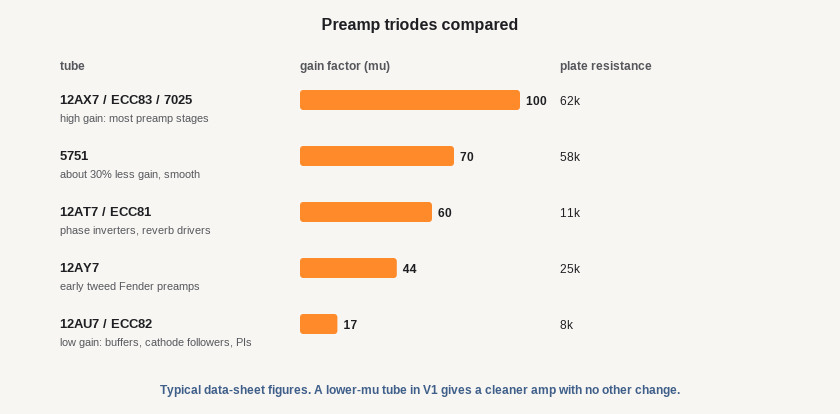
| Tube | Also sold as | Gain factor (mu) | Notes |
|---|---|---|---|
| 12AX7 | ECC83, 7025, 12AX7A, ECC803S | 100 | the standard. The 7025 and 12AX7A were low-noise, low-hum versions; today the names are used interchangeably. |
| 5751 | 70 | a lower-gain, low-noise version first made for avionics | |
| 12AY7 | 6072 | 44 | a mild-gain tube used in early tweed Fender preamps |
All share one pinout and heater, so any of them fits any 12AX7 socket. That makes them the easiest tone change in a tube amp (Level 3 covers how).
What It Does
The 12AX7's job is voltage gain. A guitar puts out a fraction of a volt; a 12AX7 gain stage multiplies it by roughly 35 to 60. Each tube holds two such stages, so one tube can raise a guitar signal from a tenth of a volt to tens of volts. Chain enough stages together and the later ones are driven into clipping: that is how a tube preamp makes distortion.
Its high gain comes with a high plate resistance (about 62,500 Ω), which means it can't drive heavy loads well. That's why other jobs, like driving a reverb tank, usually go to its lower-gain relatives.
What It Sounds Like
A 12AX7 has less character of its own than a power tube: the circuit around it decides most of the sound. But different makes do differ: some brighter, some warmer, some smoother when clipping, some quieter. Players often hear the biggest difference in V1, the first stage, because everything after it amplifies it.
Where It's Found
- Every kind of tube guitar and bass amp, in the preamp, phase inverter, reverb recovery and tremolo.
- Tube pedals and rack preamps (the Vacuum Tubes series, Level 3C, covers real-voltage and starved-plate designs).
- Hi-fi and studio gear: phono stages, line preamps and microphone preamps.
Try It
Look through the vents at the back of a tube amp with the power on: the small tubes with two glowing heaters side by side are dual triodes like the 12AX7. Most amps list their tube types on a chart inside the cabinet, from V1 at the input onward.
Level 2 covers how the 12AX7 behaves in a circuit: the gain stage, cascading, heater wiring, and noise.