Level 1 covered what the 12AT7 and 12AU7 are and why they exist. This level looks at their main jobs in an amp: driving the reverb, splitting the signal for the power tubes, buffering, and handling the effects loop.
DANGER: LETHAL VOLTAGE. Measuring or modifying these stages means working inside the chassis, at lethal voltage. Drain the filter caps and check with a meter first. The Cap Drain & Bleeder Calculator shows how.
The Reverb Driver
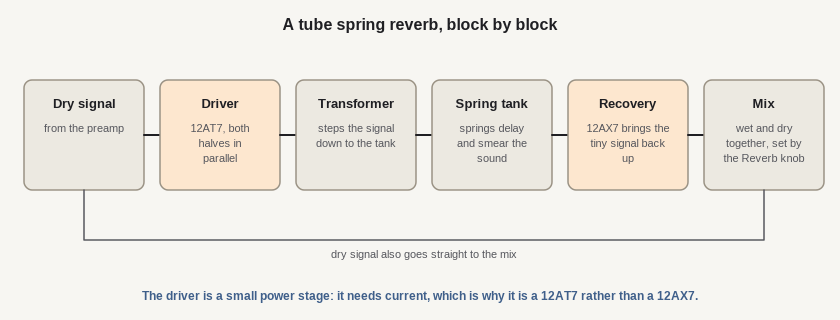
A spring reverb tank has a small input coil that needs current, not just voltage. In the classic Fender design, a 12AT7 with both halves wired in parallel drives a small transformer that feeds the tank: in effect, a tiny power amp. A 12AT7 has the current for it and enough gain to make up for the losses. The tank's output is very weak, so a 12AX7 recovers it before it is mixed back with the dry signal.
The Phase Inverter
A push-pull power stage needs two copies of the signal, one upside down (the Vacuum Tubes series, Level 2, explains why). The long-tail-pair inverter, used in most larger amps, can use a 12AX7 or a 12AT7:
- 12AT7: more current and lower output impedance. It drives big power tubes cleanly and firmly.
- 12AX7: more gain, so the inverter itself starts to overdrive sooner when the amp is turned up, adding to the power-amp breakup.
Amps were designed around one or the other, and changing it changes how the amp breaks up.
Cathode Followers and Buffers
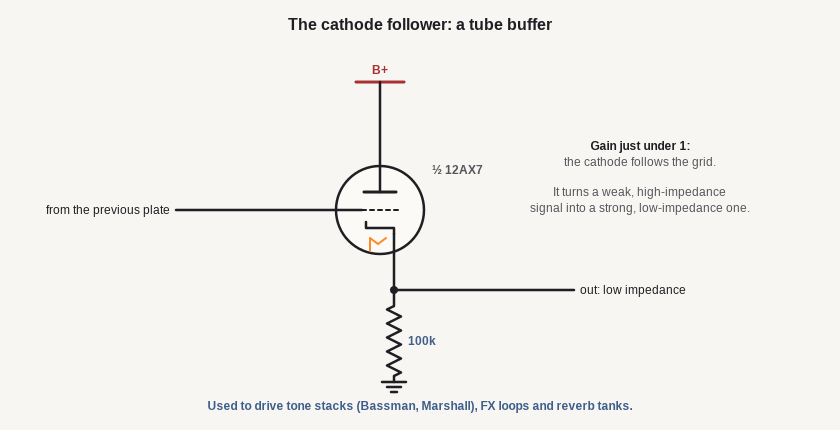
A cathode follower gains just under 1 but has a low output impedance: it turns a weak signal into a strong one able to drive a tone stack, a long cable or another circuit. It needs current, not gain, which is exactly what a 12AU7 offers. Many tube buffers and some tone-stack drivers use 12AU7s, though many classic amps use a 12AX7 half and simply live with less drive.
Driver Stages for Big Power Tubes
Large power tubes, especially in big bass amps, need a big, clean signal swing to drive them fully. A 12AU7 stage between the phase inverter and the power tubes provides it. The 300 W bass head with six 6550s uses 12AU7s as its drivers for this reason.
Effects Loop Stages
An effects loop needs a stage to send a signal out at a level pedals can take, through possibly long cables, and a stage to bring it back. A 12AT7 suits both: gain to recover the return, current to drive the send. The Buffered FX Loops series in Pedals covers loop design in depth.
The Pinout
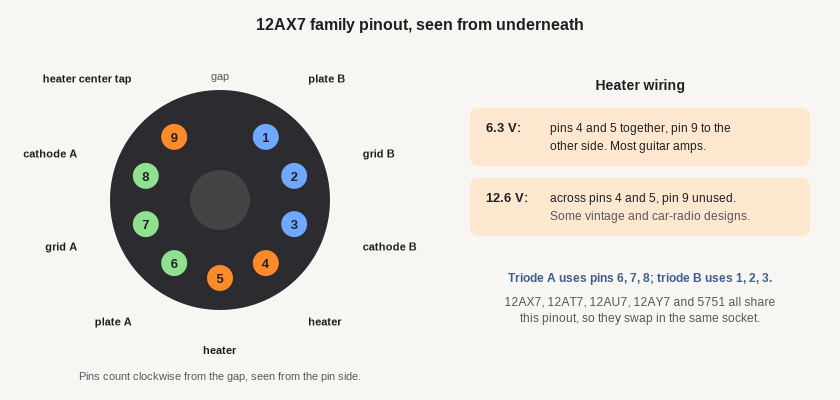
The 12AT7 and 12AU7 share the 12AX7's pinout and heater: two triodes, 6.3 V or 12.6 V heater wiring.
Try It
If your amp has spring reverb, turn the reverb up and listen to the tail. Then, with the amp off and cool, swap the reverb driver tube for a known-good spare of the same type. A reverb that sounded weak or dull and comes back to life had a worn driver: one of the most common reverb faults.
Level 3 covers where the 12AT7 and 12AU7 shine, swapping them, and buying them.