The 12AT7 and 12AU7 are the 12AX7's lower-gain siblings: dual triodes in the same 9-pin bottle, with the same pinout and heater. They give up gain in return for something the 12AX7 lacks: the ability to supply current and drive heavy loads. That makes them the tubes for the jobs between the gain stages: driving a reverb tank, splitting the signal for the power tubes, sending an effects loop down a long cable, and buffering.
This series covers both. The 12AX7 series covers their high-gain sibling, and the Vacuum Tubes series covers how tubes work in general.
DANGER: LETHAL VOLTAGE. These are small tubes, but their sockets carry high voltage whenever the amp is on, and the amp's filter capacitors hold a lethal charge after unplugging. Change tubes with the amp off and unplugged, and never reach into the chassis. The Cap Drain & Bleeder Calculator explains why.
Gain Against Current
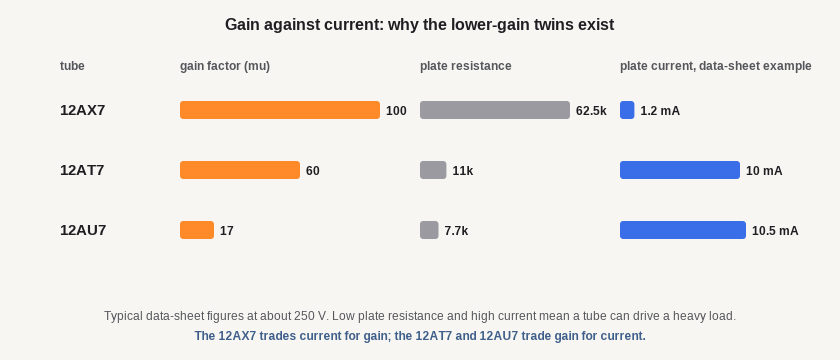
| Tube | Also sold as | Gain factor (mu) | Plate resistance | What it is good at |
|---|---|---|---|---|
| 12AX7 | ECC83 | 100 | about 62k | voltage gain from a small signal |
| 12AT7 | ECC81 | 60 | about 11k | gain and current: drivers, phase inverters, loops |
| 12AU7 | ECC82 | about 17 | about 8k | current with little gain: buffers, cathode followers, drivers |
Plate resistance is the key number. A tube with low plate resistance can push current into a heavy load without the signal sagging. The 12AT7 keeps a useful gain of 60 while carrying many times the current of a 12AX7; the 12AU7 gives up most of the gain to carry the most current of the three.
What They Sound Like
Like the 12AX7, they take most of their character from the circuit. As a substitute in a gain stage, a 12AT7 sounds cleaner and a little brighter than a 12AX7, and a 12AU7 cleaner still and darker. In the jobs they were designed for, players mainly notice them when they're wrong: a reverb that sounds weak, or a phase inverter that doesn't drive the power tubes properly.
Where They're Found
- 12AT7: the reverb driver in classic Fender reverb amps, with both halves in parallel; the phase inverter in many amps; effects loop send and return stages; and one tube in many reverb units.
- 12AU7: cathode followers and buffers; phase inverters and driver stages in big amps, such as the drivers for the six power tubes of a 300 W bass head; and one tube in the original Vox AC15. Its current capability even lets a pair of 12AU7s act as a tiny power stage of a watt or two in some mini amps.
Try It
Find your amp's tube chart (usually inside the cabinet). Note which positions hold 12AT7s or 12AU7s, and what each position does. Those are the jobs this series is about.
Level 2 covers how they work in their main jobs: the reverb driver, the phase inverter, cathode followers and loop stages.