A transistor uses a small current to control a much bigger one. Used a little, that makes it an amplifier: a tiny guitar signal in, a bigger copy out. Driven hard, it makes it an electronic switch: a few microamps from a control circuit turning a relay or an LED fully on or off. Boosts, fuzzes, buffers, LED drivers and relay switching in pedals all rest on transistors.
This series covers the classic kind, the bipolar junction transistor (BJT). FETs and MOSFETs, which work differently, have their own series.
What They Look Like
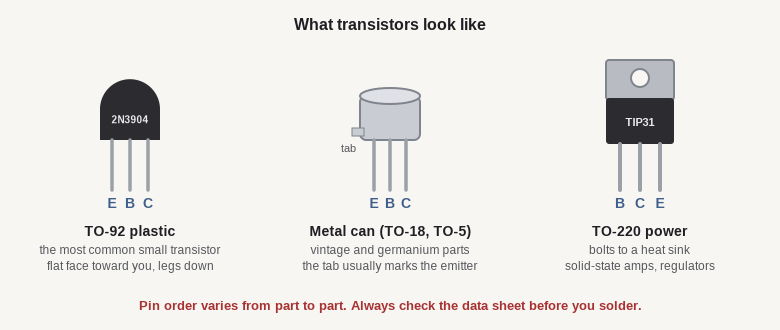
- TO-92: a small black plastic body with one flat face and three legs. The most common package by far: the 2N3904, 2N5088 and BC547 are all TO-92.
- Metal can (TO-18, TO-5 and similar): a small metal cylinder, often with a little tab on the rim. Vintage parts and most germanium transistors use them.
- TO-220: a flat plastic body with a metal tab and a mounting hole, for power transistors that bolt to a heat sink. Solid-state amps and voltage regulators use them.
The part number is printed on the flat face or the top of the can.
The Three Legs
Every BJT has three legs:
- Base (B): the control input. A small current here controls everything else.
- Collector (C): where the main current comes in.
- Emitter (E): where it goes out.
The order of the legs is not standard. A 2N3904 is E, B, C from left to right with the flat face toward you and the legs down. A BC547, which does the same job, is C, B, E. Always check the data sheet for the exact part before you solder. Level 3 has a table of common pinouts.
How It Works, Simply
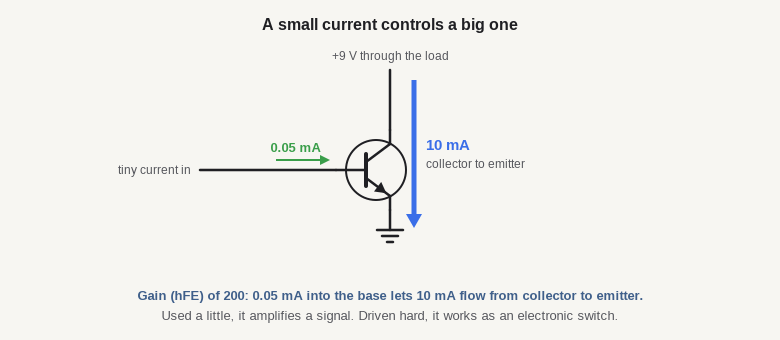
A transistor's gain, written hFE or β, is how many times bigger the collector current is than the base current. With a gain of 200, 0.05 mA into the base lets 10 mA flow from collector to emitter.
Think of a big water valve that is opened by a much smaller one. A trickle through the small valve controls a rush through the big one. A little trickle that rises and falls with your guitar signal makes the big flow rise and fall too, only bigger: that is amplification. Open the small valve all the way and the big one opens all the way: that is a switch.
The base needs a small voltage before any current flows, just like a diode: about 0.6 to 0.7 V for a silicon transistor, and about 0.2 to 0.3 V for germanium.
NPN and PNP
Transistors come in two polarities:
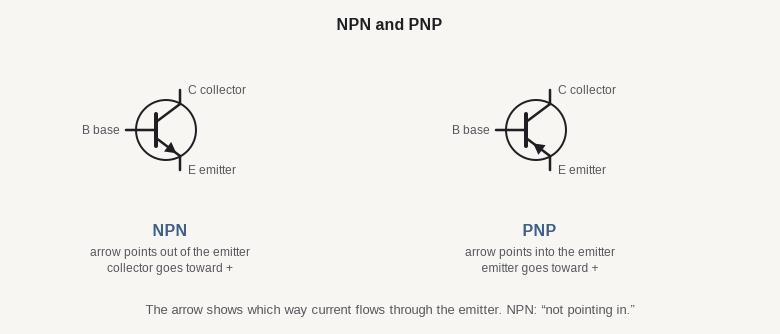
- NPN: the collector connects toward the positive supply and the emitter toward ground. Most modern pedals use NPN silicon transistors.
- PNP: the same thing turned round: the emitter connects toward the positive side. Many vintage germanium fuzzes use PNP transistors, which is why some of them run on positive ground.
On a schematic, the arrow on the emitter tells you which: on an NPN it points out (NPN: "not pointing in"), and on a PNP it points in. Transistors are labeled Q1, Q2 and so on.
Silicon and Germanium
Most transistors made today are silicon: consistent, stable with temperature, cheap and usually high in gain. Germanium transistors are the older type, found in the first fuzz pedals. They have a lower base voltage, leak a little current even when off, and change with temperature. Some players prefer their softer, warmer fuzz sound. Level 2 compares them in detail.
Common Part Numbers
| Part | Type | Where it turns up |
|---|---|---|
| 2N3904 | NPN silicon | the general-purpose workhorse: boosts, switches, LED and relay drivers |
| 2N3906 | PNP silicon | the PNP partner of the 2N3904 |
| 2N5088, 2N5089 | NPN silicon, high gain, low noise | fuzz and boost pedals |
| BC547, BC548, BC549 | NPN silicon | the European general-purpose parts; note the C, B, E pinout |
| 2N2222 | NPN silicon | general-purpose switching, in plastic or a metal can |
| MPSA18 | NPN silicon, very high gain | boosts and fuzzes |
| AC128, NKT275, OC44 and similar | PNP germanium | vintage-style fuzzes |
Where You Find Them
| In a... | What the transistors are doing |
|---|---|
| Pedal | gain stages in boosts, fuzzes and overdrives, buffers, LED drivers, relay drivers in soft-touch switching |
| Tube amp | usually none in the audio path. Some amps use them for reverb drivers, effects loops, channel switching or LED indicators |
| Solid-state amp | everywhere: preamp, tone controls and the power transistors that drive the speaker |
| Guitar | only in active guitars, as part of an onboard preamp |
Try It
In Build a Circuit, drag in Little Lift (Clean Boost): a one-transistor 2N3904 boost. Trace which leg of the transistor goes where. Then look at Furry Friend (2-Transistor Fuzz) to see two transistors working together. The Transistor Sub Box dials through common NPN and PNP part numbers on the same three legs.
Level 2 covers how transistors work in circuits: as a switch, as an amplifier, biasing, germanium versus silicon in a fuzz, and why two transistors with the same number can sound different.