Tubes wear out, slowly and then sometimes all at once. Knowing the signs saves both money on tubes that are still fine and a power transformer or output transformer from one that has failed. This level covers how tubes wear and the signs for each kind. Level 2 covers finding the bad one and choosing replacements; Level 3 covers doing the swap.
DANGER: LETHAL VOLTAGE. Tube sockets carry hundreds of volts whenever the amp is on, and the filter caps hold a lethal charge after it is unplugged. Change tubes with the amp off, unplugged and cooled, and never reach into the chassis. The Cap Drain & Bleeder Calculator explains why. New to working inside an amp? Start with On the Bench: Safe Practice.
How Tubes Wear
A tube's cathode gives off electrons when hot, and over thousands of hours it gives off fewer. Output drops, the tone gets thinner or flatter, and the tube drifts from where it was biased. Separately, parts inside can loosen (making noise and ringing), or the glass seal can leak (killing the tube outright).
How long they last depends far more on how hard they work than on the clock:
| Tube | Works | Typical life |
|---|---|---|
| Power tubes (6L6, EL34, 6V6, EL84, KT88) | hardest, at high voltage and current | from about a year of heavy gigging to several years of home use |
| Rectifier (5AR4, 5U4, 5Y3) | steadily, at high voltage | usually long; failures are often sudden |
| Preamp tubes (12AX7 and family) | at low current | many years; noise usually ends their life, not wear |
Signs, by Tube
Power tubes - The amp has lost volume, punch or headroom, and breaks up earlier than it used to. - Flabby, loose bass; a thin or fizzy top. - Hum that wasn't there before, or bias readings that have drifted and won't hold. - A blown fuse, a flash or arc inside the tube, or red plates (switch off at once).
Preamp tubes - Crackling, hiss or popping that changes when you tap the tube. - Microphonics: a ringing or howl that follows taps on the amp or loud playing. - Lost gain or a dull, flat tone. V1, the first tube, matters most: its noise is amplified by every stage after it.
Rectifier tubes - Lower volume and more sag than usual; a slow, mushy response. - Arcing or a flash inside the glass, or a blown fuse: switch off.
What to Look For on the Glass
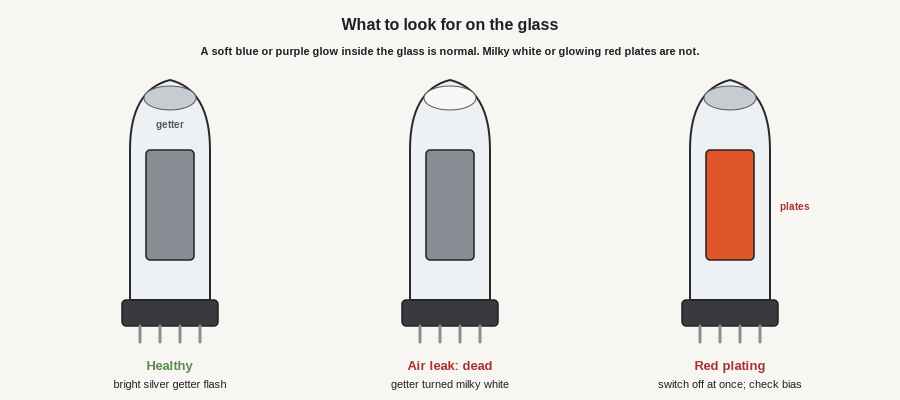
- The getter flash is the silver coating, usually at the top of the glass. It soaks up stray gas. If it turns milky white, air has got in and the tube is dead.
- A soft blue or purple glow in or on the glass is normal.
- Red or orange plates mean the tube is drawing far too much current: switch off and check the bias (On the Bench: Biasing a Tube Amp).
- A white or brown haze on the inside of the glass on an old tube is usually just age; judge the tube by how it sounds and measures.
Try It
With the amp on and warmed up, volume low and nothing plugged in, tap each preamp tube gently with a wooden chopstick. A healthy tube makes little or no sound through the speaker; a noisy or microphonic one rings, crackles or pops. Note which one; Level 2 covers what to do next.