The controls shape the sound as much as the pickups. This level covers pot values and tapers, tone caps, the treble bleed, the difference between modern and 1950s wiring, and the switches. Level 1 covers the pickups; Level 3 covers doing a swap.
Pots
| Choice | Common use | Why |
|---|---|---|
| 250k | single coils, P-90s | darker load, tames bright pickups |
| 500k | humbuckers | lighter load, keeps humbuckers clear |
| 1 meg | some bright or active setups | lightest load, most treble |
| Audio (log) taper | volume, usually tone | the volume falls evenly to the ear across the turn |
| Linear taper | some tone and blend controls | changes evenly by resistance, which sounds sudden near the bottom |
Pots vary about 20% from their marked value: a "500k" can measure 400k to 600k. Measure across the two outer lugs.
Tone Caps
The tone control is a capacitor and the tone pot in series to ground: turning it down sends more treble to ground. 0.022 µF is common with humbuckers, 0.047 µF with single coils. A bigger cap gives a darker sound with the tone rolled down.
Treble Bleed
Turning a volume pot down loses treble as well as volume. A treble bleed, a small cap (often around 1 nF, sometimes with a resistor beside it) across the volume pot's input and output lugs, lets some treble pass so the sound stays clearer as you turn down.
Modern vs 1950s Wiring
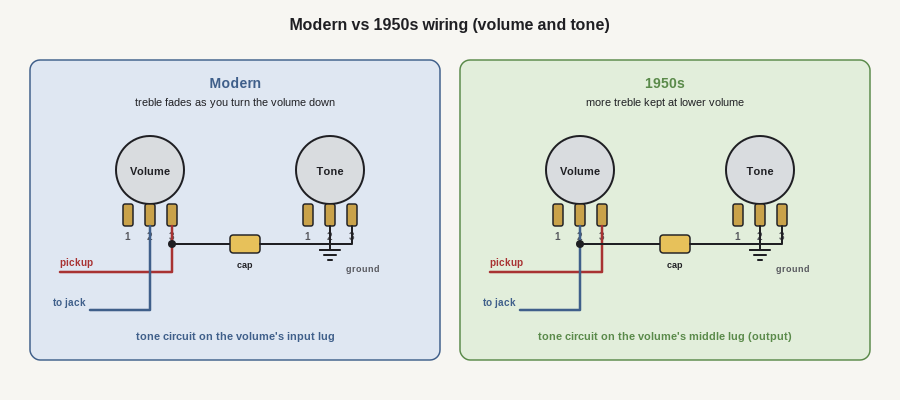
- Modern wiring connects the tone circuit to the volume pot's input lug. The two controls act separately, and treble fades as you turn the volume down.
- 1950s wiring connects the tone circuit to the volume pot's middle lug (its output). Turning the volume down keeps more treble, and the two controls interact a little.
Either is easy to switch: it's one wire.
Switches
- 3-way toggle (Gibson style): neck, both, bridge.
- 5-way blade (Strat style): neck, neck and middle, middle, middle and bridge, bridge.
- Mini toggles and push-pull pots: coil splits, series and parallel, phase. Wire them from the pickup maker's diagram.
Try It
Measure each pot in your guitar across its outer lugs, and read the value on any tone cap. Write them down: it's the first thing to check when a swap doesn't sound the way you expected.