Most dead or noisy pedals have a simple fault: the wrong power, a tired jack or a failing switch. Pedals run on low voltage, so they're safe to work on. Never open a mains power supply, though: that's mains voltage. This level covers power, and a checklist for a pedal that won't work. Level 2 covers jacks and switches; Level 3 covers mods.
Pedal Power
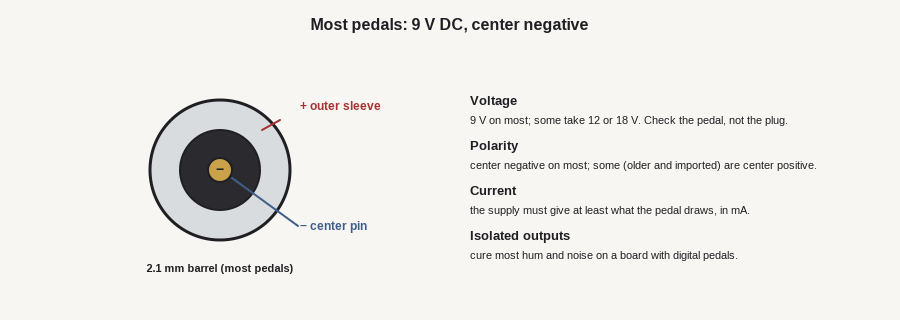
- Voltage: 9 V DC on most pedals; some take 12 or 18 V. Use what the pedal says.
- Polarity: most use a 2.1 mm barrel, center negative. Some older and imported pedals are center positive. The wrong polarity can damage a pedal without protection.
- Current: the supply must give at least the current the pedal draws (in mA). Digital pedals draw much more than analog ones.
- Isolated outputs on a power supply cure most hum and noise on a board, especially with digital pedals.
The Dead Pedal Checklist
- Another supply or a fresh battery. Many faults are the power.
- Another pair of cables, and another place on the board.
- The input jack switches the battery: most pedals only connect the battery when a cable is in the input. Unplug the input to save the battery, and check that jack if a battery-powered pedal is dead.
- The DC jack: wiggle the plug. A loose or crackly DC jack is common.
- Bypass works but the effect doesn't (or the reverse): a footswitch fault (Level 2).
- Dead after the wrong supply: many pedals have a protection diode on the power input; a reversed or over-voltage supply can blow it, or a fuse resistor beside it. These are cheap to replace, but check nothing else was damaged.
Try It
Read the label on every power supply and pedal on your board: voltage, polarity and current. Add up the pedals' current draw and compare it with what the supply can give.