A FET (field-effect transistor) does the same broad job as an ordinary transistor: a small control signal sets a much bigger current. The difference is what it takes to control it. An ordinary transistor needs a small current into its base. A FET needs only a voltage on its gate, and almost no current flows into the gate at all. That makes FETs ideal as the first stage after a guitar, which can't supply much current, and as electronic switches that a tiny logic signal can turn on.
There are two families you will meet in guitar gear: JFETs, used for buffers, boosts and preamps, and MOSFETs, used for switching, power and protection.
Voltage Control
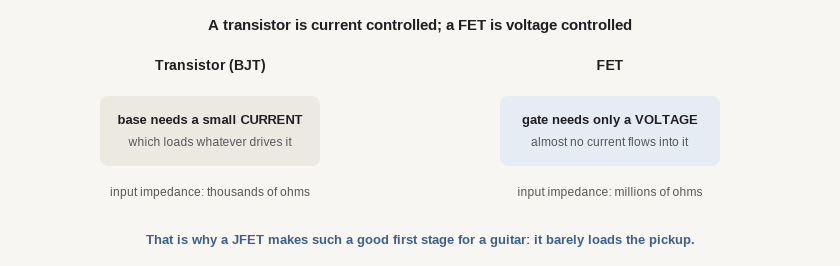
Because a FET's gate draws almost no current, a FET stage can have an input impedance in the millions of ohms. A guitar pickup barely notices it's there, so the pickup keeps its treble and its natural response. That is the main reason JFET buffers and boosts are so popular as the first pedal in a chain.
The Three Legs
| FET leg | Does the job of a transistor's... | |
|---|---|---|
| Gate (G) | base | the control input |
| Drain (D) | collector | where the main current comes in |
| Source (S) | emitter | where it goes out |
What They Look Like
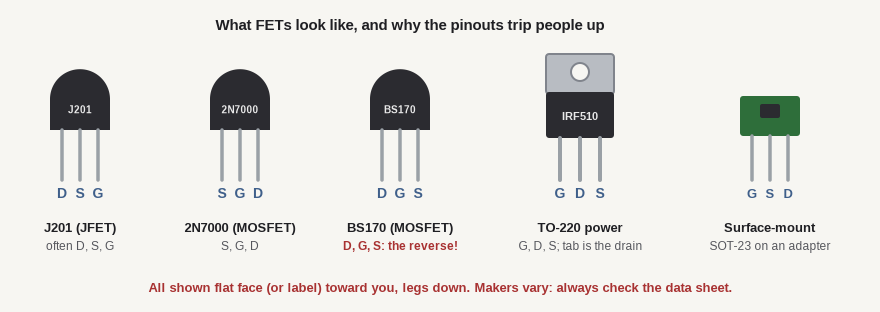
Small FETs come in the same TO-92 package as small transistors, so the part number is the only way to tell them apart. Power MOSFETs come in TO-220 packages that bolt to a heat sink. Many FETs are now made only in tiny surface-mount packages, which pedal builders buy ready-soldered onto small adapter boards with three legs.
FET pinouts are a minefield. The 2N7000 and the BS170 do almost the same job, but their pins are in opposite orders: S, G, D for one and D, G, S for the other. JFET pinouts vary by maker too. Always check the data sheet for the exact part. Level 3 has a pinout table.
JFETs and MOSFETs
JFETs (junction FETs) are on with 0 V on the gate. Pulling the gate negative turns them down and eventually off. They are quiet, have a very high input impedance and overload gently, which is why they turn up in buffers, clean boosts and pedals that set out to sound like a tube amp.
MOSFETs have a gate insulated from the rest of the part by a thin layer of glass-like oxide. The ones in guitar gear are almost all off with 0 V on the gate, and turn on when the gate goes above a set voltage. They make excellent switches: a few volts from a control circuit turns one fully on, with almost no current drawn. Power MOSFETs can switch amps of current.
That insulated gate is also their weakness: a static spark from your finger can punch through it. Level 2 covers handling.
N-Channel and P-Channel
Like NPN and PNP transistors, FETs come in two polarities:
- N-channel: the usual kind. The drain connects toward the positive supply.
- P-channel: turned round. Used where the switch has to sit in the positive supply line, as in reverse polarity protection.
On a Schematic
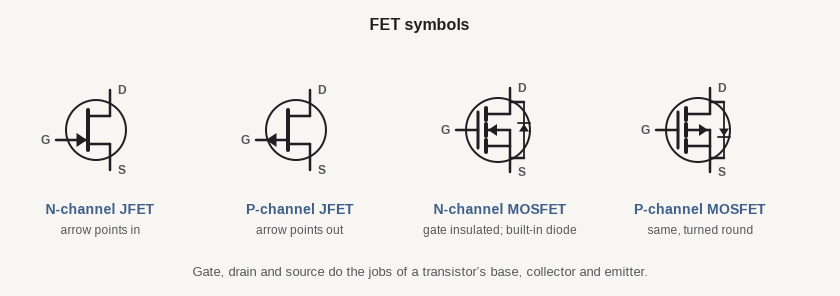
A JFET's gate line has an arrow on it: pointing in for N-channel, out for P-channel. A MOSFET's gate is drawn separated from the channel by a gap, showing the insulation, and the symbol often includes the small body diode that every power MOSFET has built in. FETs are labeled Q1, Q2 like other transistors.
Common Part Numbers
| Part | Type | Where it turns up |
|---|---|---|
| J201 | N-channel JFET, low IDSS | boosts, buffers and amp-like preamp pedals; also sold on surface-mount adapter boards |
| 2N5457 | N-channel JFET | buffers and boosts |
| MPF102 | N-channel JFET, high IDSS | boosts and preamps, older designs |
| 2N7000, BS170 | small N-channel MOSFETs | switching LEDs and relays, and some boost and clipping designs |
| IRF510, IRF520, IRF530 | N-channel power MOSFETs | power switching, some solid-state amp designs |
| IRLZ44N, IRLB8721 | logic-level N-channel power MOSFETs | switching heavy loads from a low control voltage |
Where You Find Them
| In a... | What the FETs are doing |
|---|---|
| Pedal | JFET buffers and boosts, JFET preamp stages, MOSFET switching in relay and soft-touch bypass circuits, P-channel MOSFET reverse polarity protection |
| Tube amp | rarely, except in some effects loops, channel switching or modern hybrid designs |
| Solid-state amp | preamp stages, and power MOSFETs driving the speaker in some designs |
| Guitar | JFETs in some active preamps and onboard buffers |
Try It
In Build a Circuit, drag in Smooth Buffer (JFET Buffer) and Velvet Boost (JFET Boost): both are built on a J201. Trace which leg is the gate, drain and source. The N-Channel FET Sub Box dials through JFETs and MOSFETs, from the J201 to the IRLZ44N.
Level 2 covers how FETs work in circuits: JFET buffers and boosts, biasing, MOSFET switches, reverse polarity protection, and static care.