Level 1 covered what the EZ81 and 6X4 are. This level is about how they behave: their gentle warm-up, the shared heater winding and its caution, and their current limits.
DANGER: LETHAL VOLTAGE. Everything in this article sits at the full high-voltage supply. Never measure or work on it unless you are trained to, and always drain the filter caps first. The Cap Drain & Bleeder Calculator shows how.
Gentle Warm-Up
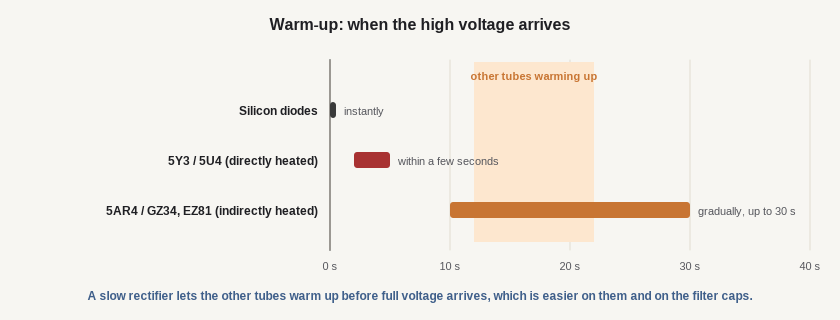
Both tubes have indirectly heated cathodes: a sleeve warmed by a separate heater. The high voltage comes up gradually as the cathode warms, at roughly the same pace as the other tubes, so the power tubes and filter caps are spared a cold-start surge.
The Shared Heater Winding
Octal rectifiers need a 5 V winding of their own, because their filament or cathode sits at the full high voltage. The EZ81 and 6X4 have a separate cathode, insulated from the heater, so they can run from the same 6.3 V winding as every other tube. That saves a winding and makes the power transformer simpler and cheaper.
The Caution
The insulation between heater and cathode is all that keeps the high voltage off the heater winding. In these tubes, the cathode sits at the full supply voltage, far above the heaters. If that insulation breaks down, the high voltage can reach the shared heater winding, and every tube heater in the amp with it. Some designs guard against this with a separate heater winding for the rectifier or other protection. A rectifier that arcs, or an amp whose heaters behave oddly, needs a technician at once.
Current Limits
| Rectifier | Current rating | Suits |
|---|---|---|
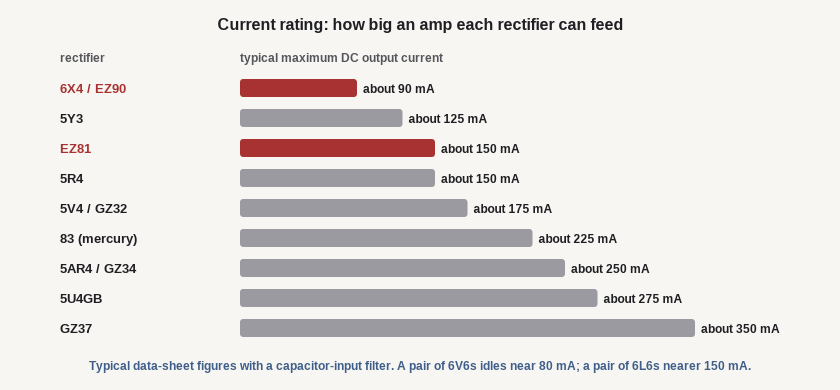
| EZ81 / 6CA4 | about 150 mA | two EL84s and a preamp, around 15 W to 18 W |
| 6X4 / EZ90 | about 90 mA | a single small power tube, or a very small push-pull pair |
Asked for more, either tube runs hot and its life shortens.
The First Filter Cap
Like all rectifier tubes, these have a maximum value for the first filter capacitor. A much larger one draws heavy charging current through the tube every cycle and shortens its life.
Signs of Wear
A worn small rectifier drops more voltage, so the amp gets quieter and softer. A failing one may arc, hum or blow the fuse. Because of the shared heater winding, a failing EZ81 or 6X4 deserves faster attention than an octal rectifier.
Try It
In a small EZ81 amp, switch on and watch the EL84s: their heaters glow, then the amp comes up gently over several seconds as the rectifier's cathode warms.
Level 3 covers where the small rectifiers shine, swapping them, and buying them.