Level 1 introduced the four less common rectifiers. This level is about how each behaves: warm-up, sag, current, heater load, and the mercury-vapor 83's cautions.
DANGER: LETHAL VOLTAGE. Everything in this article sits at the full high-voltage supply. Never measure or work on it unless you are trained to, and always drain the filter caps first. The Cap Drain & Bleeder Calculator shows how.
Warm-Up
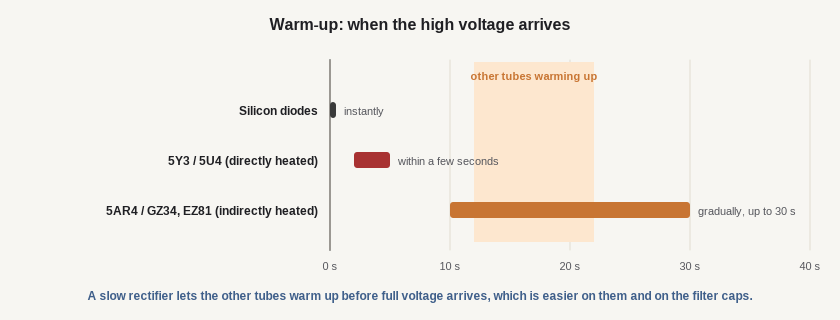
| Rectifier | Heating | Warm-up |
|---|---|---|
| 5V4 / GZ32 | indirectly heated | slow and gentle, like a 5AR4 |
| GZ37 | indirectly heated | slow and gentle |
| 5R4 | directly heated | fast, like a 5U4 |
| 83 | directly heated, mercury vapor | fast, but needs a moment for the vapor to form |
Sag
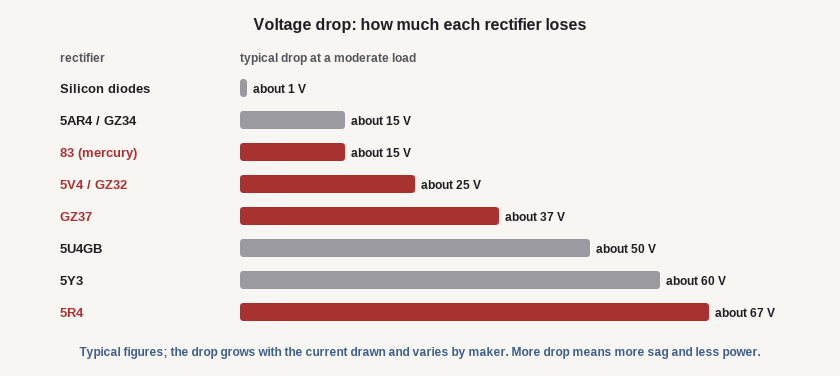
The more drop a rectifier has, the more its supply dips under load. The 83 and 5V4 sit near the firm end, the GZ37 in the middle, and the 5R4 near the soft end with the 5Y3 and 5U4. Players describe the 5R4 as giving a mid-level sag in small amps.
Current and Heater Load
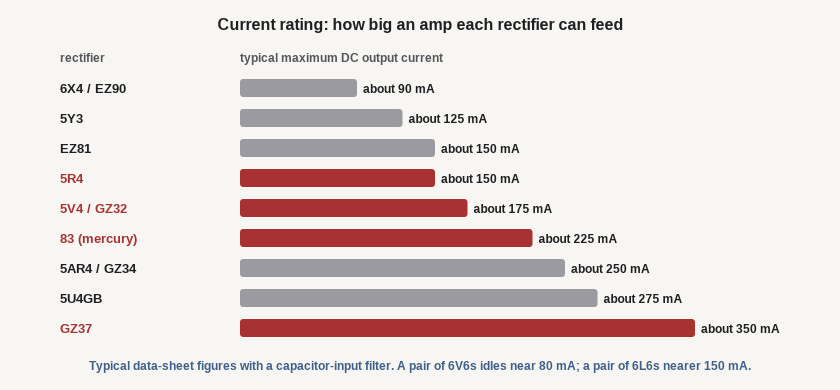
- 5V4 / GZ32: about 175 mA, enough for a modest medium amp, but less than a 5AR4.
- 5R4: rated for high voltage, not high current; about 150 mA with a capacitor-input filter.
- GZ37: about 350 mA, the most of the common rectifier tubes, but its heater draws 2.8 A.
- 83: about 225 mA, with a 3 A heater.
Heater current matters whenever you swap: the 5 V winding must supply the new tube's heater without overheating, and a lower-current tube lets the winding's voltage rise.
The 83's Cautions
The 83 conducts through mercury vapor rather than a heated cathode, which gives it a low, steady drop. But mercury vapor can arc back if the tube is cold, overloaded or worn, effectively shorting the supply. It also gives off radio-frequency noise unless the amp suppresses it. Players and restorers treat original 83s as precious and keep them for amps built around them.
Signs of Wear
As with any rectifier, a worn one drops more voltage, and a failing one may arc, hum or blow the fuse. In an 83, a bright blue glow is normal mercury vapor; flashing or sparking is not.
Try It
If you own a 5AR4 amp and a 5V4 is on hand, swap with the amp off and drained, then compare the two at the same volume. Players often find the difference small, which is itself useful to know.
Level 3 covers where each fits and the swaps that make sense.