Level 1 covered what the 5U4 is and how it feels. This level is about how it behaves: sag, its fast warm-up, its heavy heater, current limits, and filter cap limits.
DANGER: LETHAL VOLTAGE. Everything in this article sits at the full high-voltage supply. Never measure or work on it unless you are trained to, and always drain the filter caps first. The Cap Drain & Bleeder Calculator shows how.
Real Sag
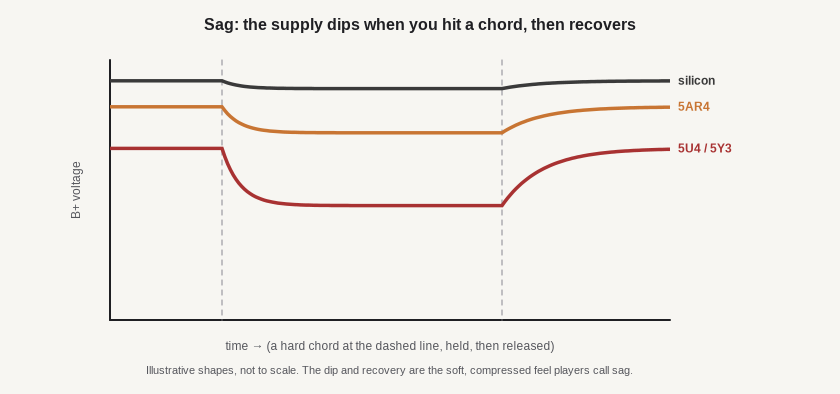
A 5U4's internal resistance is high, so when a hard chord makes the power tubes draw more current, the supply dips well below its idle value and recovers slowly as the chord fades. The amp compresses its peaks, and as the voltage swells back, the gain swells with it: the bloom and sustain that blues players in particular like. Small filter caps, as in vintage amps, make it more pronounced.
Fast Warm-Up
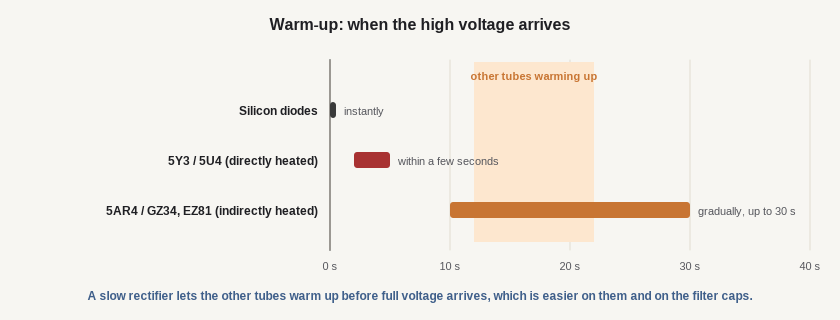
The 5U4 is directly heated: its filament is also its cathode, so it conducts within a few seconds of switch-on, before the amplifying tubes have warmed. For those seconds the supply rises above its working voltage, because nothing is drawing current yet. Amps designed around the 5U4 have filter caps rated for that, but it is worth remembering when replacing caps or swapping rectifiers.
The 3 A Heater
A 5U4GB draws 3 A from the power transformer's 5 V winding: more than a 5AR4 (1.9 A) or a 5Y3 (2 A). A winding built for a 5AR4 may not supply it without running hot. Before fitting a 5U4 to any amp that didn't come with one, the 5 V winding's rating needs checking; one way technicians do it is to measure how far the winding's voltage drops under the 5U4's load.
Current Limits
At around 275 mA, the 5U4GB has the current for a pair of 6L6s in a 40 W to 50 W amp. Larger amps either used two in parallel, as the 1955 Bassman did, or silicon diodes.
The First Filter Cap
Like any rectifier tube, the 5U4 has a maximum value for the first filter capacitor. A much larger cap draws heavy charging current through the tube and shortens its life.
Signs of Wear
A worn 5U4 drops more voltage, so the amp gets quieter and mushier than usual. A failing one may glow unevenly, arc, hum or blow the fuse. Replace an arcing rectifier at once and have the filter caps and fuse checked.
Try It
On a 5U4 amp turned up to just break up, play a hard chord and let it ring. Listen for the slight dip in volume and the swell back as the note decays: that is the 5U4's sag.
Level 3 covers where the 5U4 shines, swapping it, and buying them.